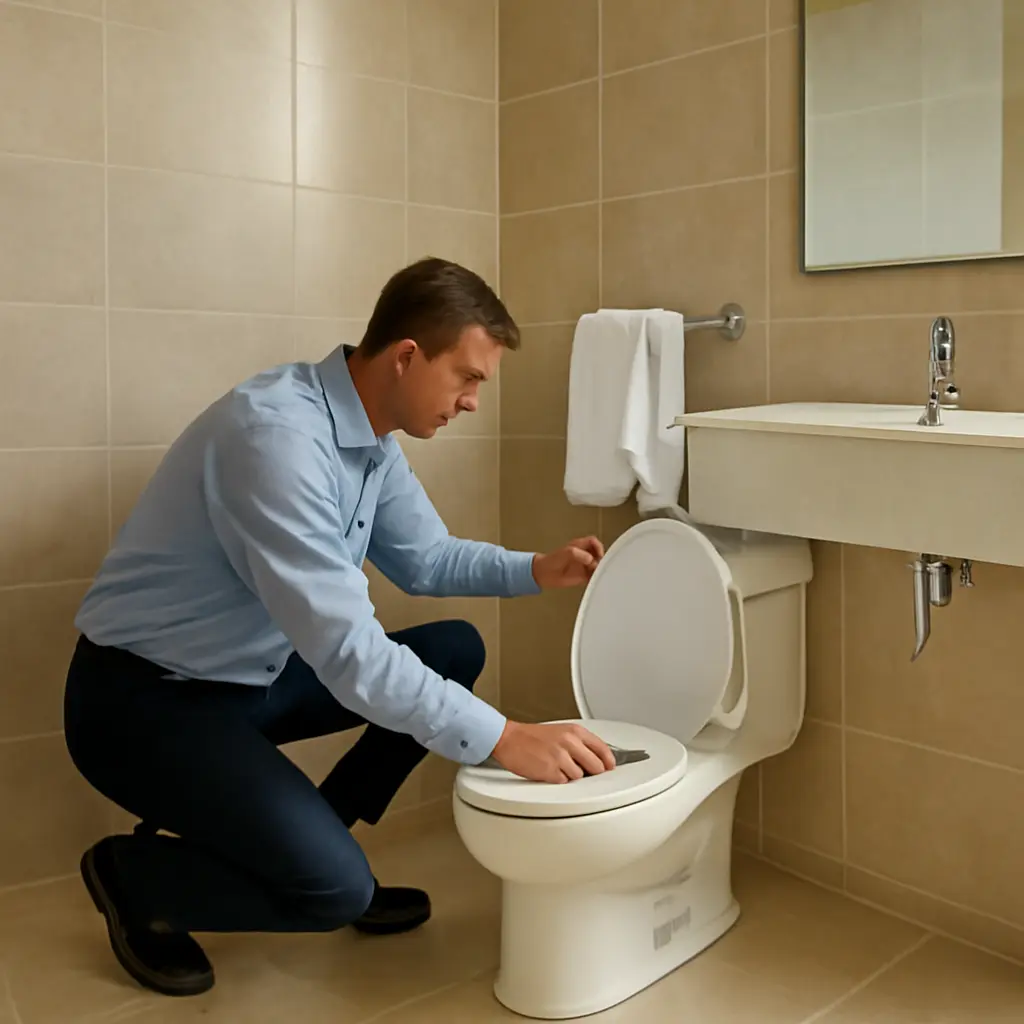
Low-flow toilets are water-efficient fixtures designed to use substantially less water per flush than older conventional models. In hotels and other hospitality venues, replacing inefficient toilets can reduce water use, sewer charges, and the energy needed to heat and move water—often without guests noticing a difference in ordinary use. The U.S. Environmental Protection Agency (EPA) says WaterSense-labeled toilets use no more than 1.28 gallons per flush (gpf), at least 20% less than the federal standard of 1.6 gpf, while meeting performance requirements. For operators, the case for upgrading rests on three connected questions: how much water the fixtures save, how reliably they perform, and how to install and maintain them without disrupting the guest experience.
How low-flow toilet efficiency reduces hospitality water demand
Toilet efficiency is the volume of water a fixture uses to remove waste in a single flush, measured in gallons per flush. EPA’s WaterSense program defines a qualifying high-efficiency toilet as one that uses 1.28 gpf or less and independently verifies both water efficiency and flushing performance. That definition matters in hospitality: a lower flush volume is valuable only when the fixture clears the bowl consistently and does not prompt repeat flushing.
Older toilets installed before federal efficiency standards can use 3.5 to 7 gpf, according to EPA consumer guidance. The federal standard for toilets manufactured after 1994 is 1.6 gpf. Replacing a 3.5-gpf toilet with a 1.28-gpf model therefore cuts flush volume by about 63% per use; replacing a 1.6-gpf fixture cuts it by 20%. Actual property-wide savings depend on occupancy, fixture condition, guest behavior, and whether the flushometer or tank is correctly matched to the bowl.
Tank toilets and flushometer toilets
Tank toilets store water in a reservoir and release it by gravity or pressure assistance. Flushometer toilets, common in hotel public restrooms, connect directly to a pressurized water supply and use a flush valve. Both types are available in efficient models, but they have different installation and maintenance needs: tank systems depend on the tank, fill valve, and flapper, while flushometers require a properly calibrated valve and compatible bowl.
EPA’s WaterSense specification applies to tank-type toilets, while commercial flushometer-valve and bowl combinations require careful equipment selection and verification against applicable standards and local codes. A facility should not assume that a low-volume valve will perform properly on every existing bowl. Manufacturers’ compatibility guidance and a qualified plumber’s assessment help prevent weak flushes, repeat flushing, and service calls.
Estimating property-level water savings
A basic estimate compares the old and new flush volumes, then multiplies the difference by annual flushes. For example, replacing a 3.5-gpf toilet with a 1.28-gpf model saves 2.22 gallons per flush. At 10,000 flushes a year, that equals 22,200 gallons annually for one fixture, before accounting for any changes in guest use or maintenance-related losses.
This calculation is a planning estimate, not a universal hotel benchmark. The EPA’s WaterSense program reports that replacing old, inefficient toilets with WaterSense-labeled models can save an average household thousands of gallons annually; a hotel’s results will vary with room count, occupancy, flush frequency, and fixture mix. Operators can improve estimates by combining fixture inventories with water-meter data and occupancy records, then checking whether measured consumption changes after installation.
How reliable performance protects the guest experience
Guest-facing performance means the toilet works as expected, is easy to operate, and does not create avoidable noise, delays, or maintenance interruptions. Low-flow technology has improved considerably since early low-volume designs, but a water-saving label alone cannot compensate for poor installation, an incompatible bowl and valve, or neglected repairs. For a hotel, the practical goal is not merely a lower flush volume; it is dependable operation at that volume.
Third-party testing and product selection
WaterSense-labeled tank toilets are independently certified to meet EPA efficiency and performance criteria. EPA’s specification requires effective waste removal under standardized testing, helping distinguish verified products from fixtures that are marketed as efficient without the same third-party certification. When comparing products, facilities should also consider bowl shape, seat height, accessibility, replacement-part availability, and whether the model is suitable for the room’s plumbing and expected use.
For high-use public restrooms, procurement teams should evaluate the complete fixture assembly rather than selecting a valve by flush volume alone. A small pilot installation can reveal whether the chosen equipment performs well under the property’s water pressure and usage patterns before the hotel commits to a building-wide retrofit.
Maintenance prevents hidden water waste
A leaking toilet can erase some of the savings from an efficient fixture. EPA WaterSense guidance notes that a silent leak from a worn flapper may waste hundreds of gallons per day, depending on the leak rate and supply pressure. Because these losses may not be obvious to guests or staff, routine checks are an important part of water-efficiency work.
Maintenance teams can inspect tank components, flushometer valves, supply connections, and bowl performance during preventive-maintenance rounds. Useful indicators include unexplained increases in overnight or low-occupancy water-meter readings, repeated guest reports, and toilets that require multiple flushes. Repairing leaks promptly protects both water savings and the guest experience.
How toilet retrofits support hospitality sustainability
Hospitality sustainability is the reduction of environmental impacts across lodging operations while maintaining safe, comfortable service. Toilets are one component of that effort, alongside showers, faucets, laundry, cooling systems, and irrigation. Their importance comes from repeated use: a modest reduction per flush can add up across dozens or hundreds of rooms and shared facilities.
Water, wastewater, and operating costs
Reducing potable-water demand can lower water bills and, where charges are linked to water consumption, wastewater expenses. The U.S. Geological Survey explains that freshwater is a limited resource, and the EPA’s WaterSense program identifies toilets as a significant source of indoor residential water use. Hotels have different patterns from households, but the same basic opportunity applies: less water entering a fixture can mean less water purchased and discharged.
Financial results depend on local water and sewer rates, installation costs, fixture life, and the volume of use. A useful business case should include those factors rather than promise a fixed payback period. It should also account for avoided leak losses and the operational value of standardizing parts across rooms or properties.
Energy and emissions implications
Water efficiency can also reduce energy demand when a property pumps, treats, or heats water. Toilet flushing generally uses cold water, so its direct hot-water savings are limited compared with showers and sinks. However, municipal water and wastewater systems require energy to move and process water, and on-site pumping also consumes electricity. The resulting emissions benefit varies by location and energy supply, so operators should describe it as a potential indirect benefit rather than a fixed reduction.
For credible sustainability reporting, hotels can track fixture counts, estimated flush-volume reductions, utility bills, and measured water consumption. Separating measured outcomes from modeled estimates makes environmental claims more transparent and useful to owners, guests, and auditors.
A practical retrofit plan for hotels
A phased retrofit lets operators prioritize the least efficient fixtures, test product performance, and manage capital spending. A straightforward process is:
- Inventory toilets by type, age, flush volume, condition, and location.
- Review water bills and meter data to establish a baseline, accounting for occupancy and seasonal variation.
- Check plumbing codes, accessibility requirements, water pressure, and fixture compatibility.
- Test selected products in a small number of guest rooms and public restrooms.
- Train maintenance staff, stock suitable replacement parts, and record repairs.
- Compare post-installation water use with the baseline and adjust the program where performance falls short.
A useful visual for an internal sustainability report is a before-and-after chart showing flush volume, annual estimated flushes, and measured property water consumption. Include occupancy alongside consumption so readers can distinguish efficiency gains from changes in the number of guests.
Conclusion: low-flow toilets make invisible sustainability measurable
Low-flow toilets can reduce hospitality water demand while remaining unobtrusive to guests when properties choose tested, compatible fixtures and maintain them well. EPA WaterSense criteria provide a clear benchmark for efficient tank toilets, while commercial flushometer installations need appropriate valve-and-bowl matching. Savings can extend to water and wastewater costs, with possible indirect energy benefits, but actual results depend on local conditions and operating practices.
Hotels can begin by auditing fixture types, identifying older or leaking units, and piloting suitable replacements before scaling up. Track both modeled savings and utility-meter results, and include occupancy in performance comparisons. This makes a quiet plumbing upgrade part of a broader, credible sustainability program—and helps operators conserve resources without asking guests to change their routines.
Sources: U.S. Environmental Protection Agency, WaterSense: Toilets, https://www.epa.gov/watersense/residential-toilets; U.S. Environmental Protection Agency, WaterSense Specification for Tank-Type Toilets, https://www.epa.gov/watersense/product-specifications; U.S. Environmental Protection Agency, Fix a Leak Week, https://www.epa.gov/watersense/fix-leak-week; U.S. Geological Survey, Where Is Earth’s Water?, https://www.usgs.gov/special-topics/water-science-school/science/where-earths-water; U.S. Department of Energy, Federal Requirements for Toilets, https://www.energy.gov/eere/femp/purchasing-energy-efficient-commercial-and-industrial-equipment.