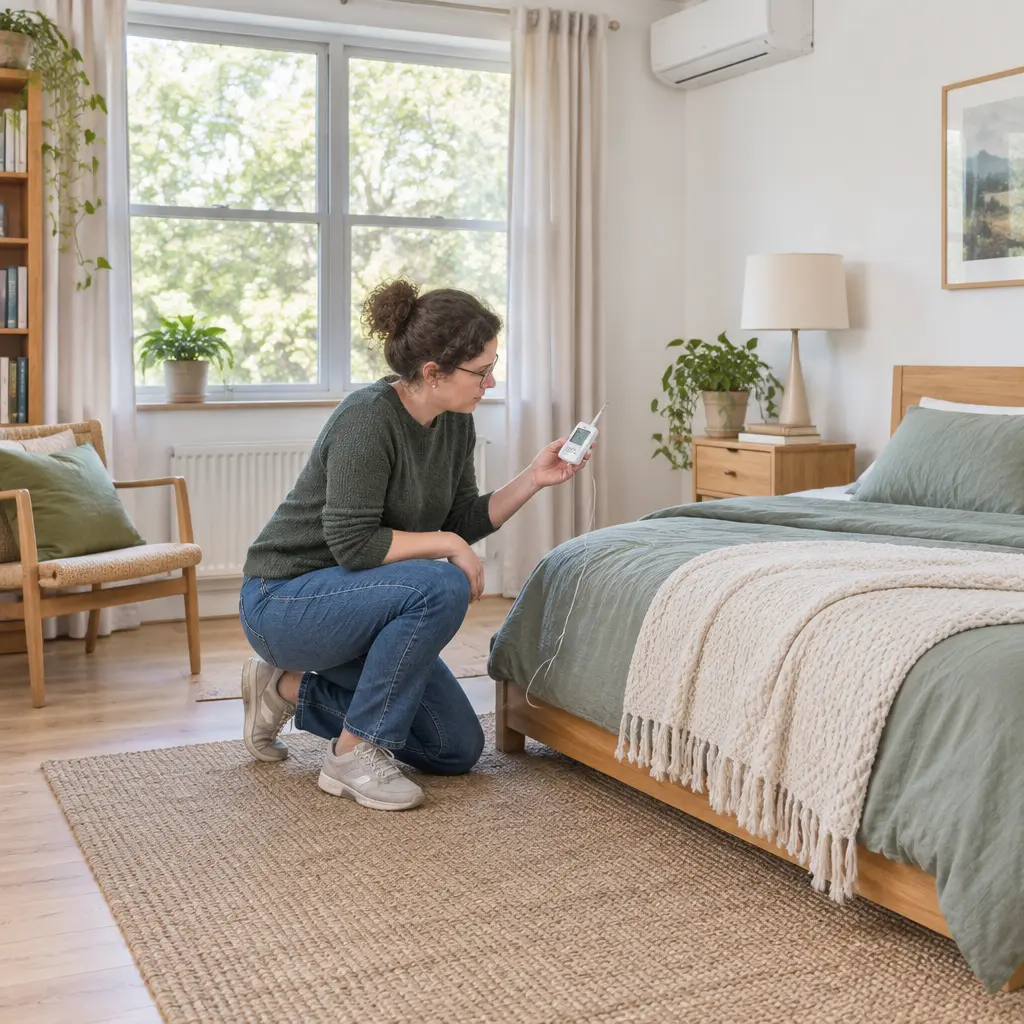
Room comfort engineering is the measurement and adjustment of indoor conditions—especially temperature, humidity, air movement, and radiant heat—to support occupants’ needs. Before claiming that a climate-control feature improves sleep quality, researchers should first test whether it reliably changes the room environment people actually experience. This distinction matters because sleep is sensitive to thermal conditions, but a responsive thermostat alone does not prove better sleep. The World Health Organization recommends keeping indoor temperatures high enough to protect health in cold weather, while sleep research shows that thermal comfort depends on multiple interacting factors, not a single universal setpoint. A sound evaluation therefore links device response, measured room conditions, occupant exposure, and validated sleep outcomes.
Climate-control responsiveness defines room comfort engineering
Room comfort engineering applies building science, environmental measurement, and control-system design to assess how indoor conditions affect occupants. ASHRAE Standard 55 defines thermal comfort as the condition of mind that expresses satisfaction with the thermal environment; its assessment considers factors such as air temperature, radiant temperature, humidity, air speed, clothing, and activity. In sleep studies, responsiveness is a narrower, testable property: how quickly and consistently a system detects a change, acts on it, and brings the occupied sleeping zone toward a specified condition.
That definition separates three claims that are often conflated: a controller issued a command, the room’s thermal conditions changed, and the change improved sleep. The first is a device-performance claim; the second is an environmental-performance claim; the third requires evidence from people and sleep outcomes. A system may respond quickly at its sensor while a bed-level logger records little change, or it may achieve a comfortable temperature without improving sleep for a particular participant.
Thermal conditions are more than thermostat setpoints
A thermostat setpoint is the target entered into a control system, not a complete description of the sleeper’s exposure. Air temperature can differ across the room and from mean radiant temperature—the combined thermal effect of surrounding surfaces. Relative humidity and air speed also influence perceived warmth and moisture loss. ASHRAE’s comfort framework therefore evaluates combinations of environmental and personal variables rather than treating one temperature as universally comfortable.
Sleep research supports this multivariable approach. A review by K. Kräuchi and colleagues describes links between thermoregulation and sleep, including the role of body-temperature rhythms and heat loss around sleep onset. The implication for engineering is practical: record conditions near the sleeper and at relevant times, rather than inferring exposure from a wall thermostat or a daily room average.
Responsiveness is a measurable control-system attribute
Climate-control responsiveness can be characterized by detection delay, actuation delay, settling time, overshoot, stability, and recovery after a disturbance. For example, a test can define the time between a measured temperature crossing a threshold and the system beginning a corrective action, then measure how long the bed-zone temperature takes to enter and remain within a predefined band.
These metrics should be reported with the test conditions: room size, equipment capacity, sensor position, outdoor conditions, door opening, occupancy, and control settings. Without that context, a statement such as “rapid cooling” is difficult to reproduce or compare. Responsiveness is not itself a sleep benefit; it is an upstream engineering result that must be verified before health or sleep-quality claims are considered.
Room comfort testing validates climate-control responsiveness
A room comfort test evaluates whether a climate-control system produces the intended environmental change where occupants sleep. The U.S. Department of Energy’s guidance on thermostats emphasizes that control settings and schedules affect heating and cooling operation, but a scheduled command does not establish that the occupied zone reached the desired condition. Testing should therefore compare controller logs with independent measurements from the room.
The most useful test categories are complementary: instrumented environmental monitoring establishes what happened in the room; controlled disturbance testing measures how the system reacts; and field testing checks whether performance persists under ordinary use. Together, they form a bridge from equipment operation to occupant exposure without prematurely claiming a sleep outcome.
Instrumented room monitoring measures actual exposure
Instrumented monitoring uses calibrated sensors to record air temperature and relative humidity, with additional measurements of air speed or radiant conditions when the study question requires them. Place loggers near the bed at approximately occupant level, away from direct supply-air jets, windows, heaters, and sunlight; use a second location near the thermostat to identify spatial differences. Record at a consistent interval fine enough to capture control cycles and transient changes.
The U.S. Environmental Protection Agency notes that indoor humidity control is relevant to moisture and mold management; its general guidance commonly advises keeping relative humidity below 60%, ideally within a 30%–50% range where practicable. These are building-health and moisture-control guidelines, not a universal sleep prescription. A sleep study should state why its chosen humidity range is appropriate and report any departures rather than presenting a single humidity target as medically established.
Disturbance tests reveal response time and stability
A disturbance test applies a controlled change—such as a modest setpoint step, a brief door opening, or a repeatable heat load—and tracks the room’s response. Researchers can calculate response latency, time to reach the target band, overshoot, and the duration of subsequent oscillations. Tests should use safe, predefined limits and be repeated, because one successful cycle may not represent performance across different weather or occupancy conditions.
A useful chart would plot temperature and humidity at the bed and thermostat against time, with the control command and disturbance marked. Such a graph can show whether the system corrected a room-wide condition or merely changed the air near its sensor. It also makes control cycling and delayed recovery visible—features that a single before-and-after reading would miss.
Field tests establish real-world reliability
Field testing observes the system during ordinary nights, capturing variation in outdoor weather, occupant behavior, bedding, door use, and schedule adherence. Researchers should document these factors and distinguish nights with equipment faults or unusual disruptions. A crossover design—in which participants experience more than one control condition in randomized order—can help separate system effects from stable differences between people, provided the study is appropriately powered and ethically reviewed.
Real-world testing is particularly important for adaptive or “smart” controls. A learning algorithm may perform differently after it has accumulated usage data, and its predictions may be affected by changed routines. A field report should therefore describe the algorithm version, learning period, sensor configuration, override behavior, and missing-data rules so another team can interpret or reproduce the results.
Sleep-quality claims require separate validation
Sleep quality is an outcome involving sleep continuity, timing, perceived restfulness, and sometimes objective measures of sleep stages. The National Heart, Lung, and Blood Institute describes healthy sleep in terms that include sufficient duration and quality, while recognizing that individual needs vary. Consequently, showing that a room reached a target temperature does not establish that occupants slept better; the outcome must be measured independently and compared with an appropriate baseline or control.
The evidence chain should be explicit: climate-control action changes measured exposure; exposure differs between test conditions; and sleep outcomes differ in a way that is statistically and practically meaningful. If any link is missing, claims should be limited to the link actually tested. This prevents an engineering performance metric from being marketed as a health result.
Objective and subjective sleep measures answer different questions
Actigraphy estimates sleep and wake patterns from movement, while polysomnography records physiological signals and is used to assess sleep stages and disorders in clinical or research settings. Sleep diaries and validated questionnaires capture perceived sleep, awakenings, and morning restfulness. Each method has limitations: actigraphy can misclassify quiet wakefulness, while self-report is influenced by memory and expectations.
A credible study can combine measures rather than treating one as definitive. For example, it may use actigraphy for nightly continuity, a validated questionnaire for perceived quality, and a diary for bedtime and awakenings. The protocol should identify primary and secondary outcomes in advance; otherwise, testing many endpoints can make isolated positive findings appear stronger than they are.
Study design must control confounding factors
Sleep is affected by noise, light, stress, illness, caffeine, alcohol, medications, work schedules, bedding, and household routines. If these factors differ between climate-control conditions, they can obscure or imitate an environmental effect. Randomization, consistent measurement, participant-level baseline data, and transparent analysis help reduce this risk.
Researchers should also report sample size, participant characteristics, study duration, exclusions, missing data, and uncertainty around estimated effects. A statistically significant difference may be too small to matter to occupants, while a potentially useful effect may remain uncertain in a small sample. Claims should match the strength and scope of the evidence—for example, “reduced measured temperature variation in this room” is narrower and more defensible than “improves sleep.”
Ethical and safety limits belong in the protocol
Studies should avoid exposing participants to unsafe heat, cold, or humidity and should provide a way to override automated control. The World Health Organization’s housing and health guidance discusses indoor temperature as a health-relevant condition and recommends a minimum indoor temperature of 18°C (64.4°F) in cold seasons for the general population, with higher temperatures potentially needed for vulnerable groups. This is a public-health recommendation, not a universal experimental setpoint or an ideal sleep temperature.
Protocols should define stop criteria, disclose risks, protect participant data, and obtain appropriate ethics review. For vulnerable participants—such as older adults, infants, or people with relevant medical conditions—researchers should use population-specific safety guidance and avoid assuming that findings from healthy adults apply to them.
A staged validation framework connects engineering to sleep evidence
A staged framework allows teams to make progressively stronger claims only as evidence accumulates. First confirm sensor accuracy and control operation; next verify room-level response under repeatable conditions; then test performance during occupied nights; and only after that evaluate sleep outcomes using a suitable human-study design. This approach is useful for manufacturers, building operators, researchers, and reviewers assessing climate-control products.
- Check calibration, sensor placement, control logs, and data synchronization.
- Measure baseline room conditions and spatial variation at the sleeping zone.
- Run repeatable response tests and report latency, settling, overshoot, and stability.
- Verify performance over multiple occupied nights while recording relevant confounders.
- Evaluate prespecified sleep outcomes against a control or baseline, and report uncertainty and limitations.
A practical example is a bedroom cooling system tested first with independent temperature and humidity loggers, then under a controlled setpoint change, and finally in a randomized comparison of ordinary and responsive-control nights. If the device reduces bed-zone temperature swings but sleep outcomes do not differ, the supported conclusion is improved environmental control—not improved sleep. If sleep measures do differ, the study still needs to show that the change is attributable to the intervention and is meaningful for the tested population.
Conclusion: test room response before making sleep claims
Room comfort engineering clarifies what a climate-control system does, where it does it, and how consistently it changes occupant exposure. ASHRAE’s thermal-comfort framework shows why temperature alone is incomplete; instrumented and disturbance testing establish responsiveness; and well-designed sleep studies determine whether environmental changes correspond to better sleep. Public-health temperature and humidity guidance can inform safety and building practice, but it should not be recast as proof of a universal sleep optimum.
For any product or research claim, ask for bed-zone measurements, repeatable response metrics, transparent study methods, and independently measured sleep outcomes. Engineers and researchers should publish the protocol and limitations before extending an equipment-performance result into a health claim. That discipline improves consumer trust and supports climate-control systems that are both technically reliable and honestly evaluated.
Sources: ASHRAE, ANSI/ASHRAE Standard 55-2023, Thermal Environmental Conditions for Human Occupancy, https://www.ashrae.org/technical-resources/bookstore/standard-55-thermal-environmental-conditions-for-human-occupancy; Kräuchi, K. et al., “Thermoregulation and sleep,” Current Opinion in Physiology, 2018, https://doi.org/10.1016/j.cophys.2018.07.004; U.S. Environmental Protection Agency, A Brief Guide to Mold, Moisture and Your Home, https://www.epa.gov/mold/brief-guide-mold-moisture-and-your-home; U.S. Department of Energy, Programmable Thermostats, https://www.energy.gov/energysaver/programmable-thermostats; National Heart, Lung, and Blood Institute, Healthy Sleep, https://www.nhlbi.nih.gov/health/sleep/healthy-sleep; World Health Organization, WHO Housing and Health Guidelines, https://www.who.int/publications/i/item/9789241550376.