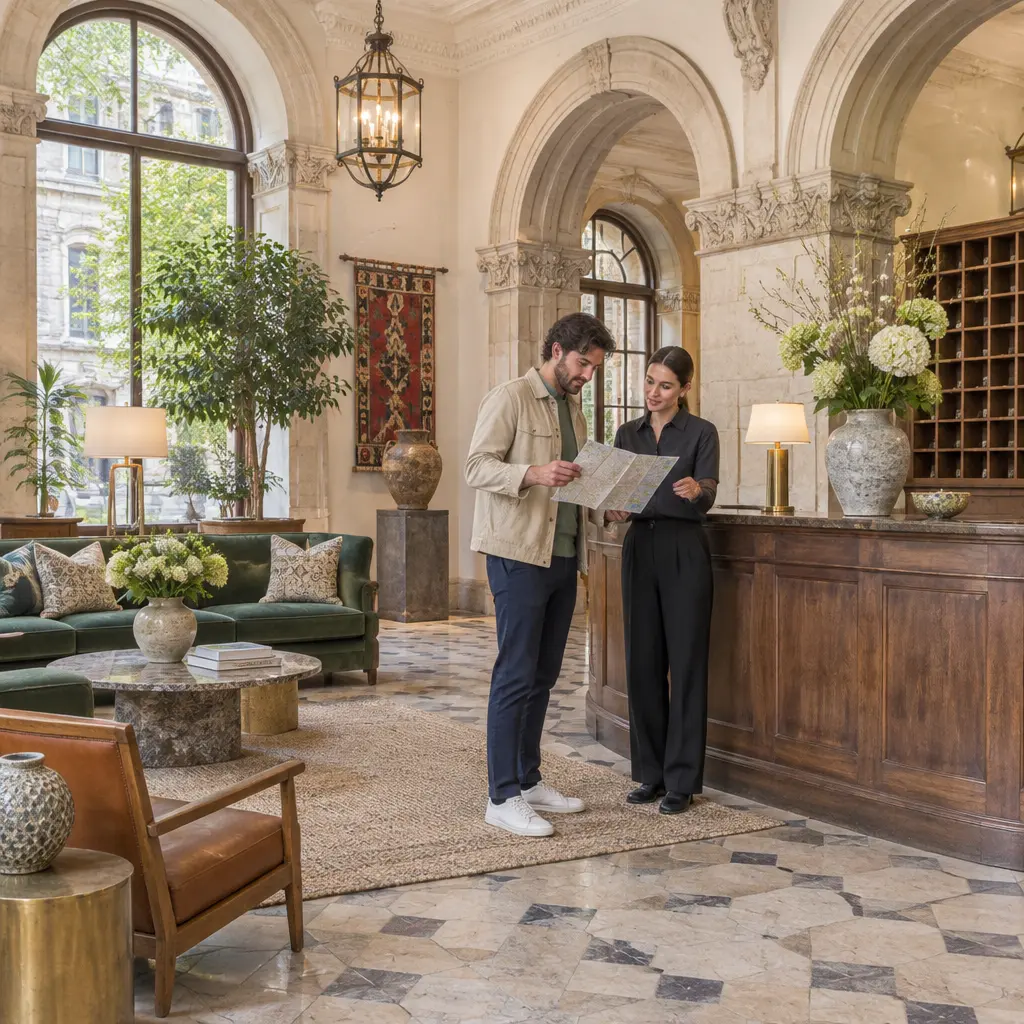
A boutique hotel’s authenticity is the degree to which its identity, setting, design, and hospitality feel meaningfully connected to a real place and its people—not simply assembled to look unusual. There is no single industry-wide score for “genuine character,” but research on tourism, brand authenticity, and guest experience points to practical ways to evaluate it: check whether local history and culture shape the property’s choices, whether the design and service are coherent, and whether the hotel’s claims are supported by visible practices. This matters in a competitive market: the American Hotel & Lodging Association reported that U.S. hotels generated $327.4 billion in guest spending in 2023, while travelers’ reviews and recommendations increasingly influence accommodation choices. The sections below distinguish grounded character from manufactured quirkiness, offer criteria for assessment, and illustrate the difference with real-world examples.
Evaluating Boutique Hotel Authenticity Through Place, Design, and Service
“Boutique hotel” has no universally binding definition. In common industry use, it describes a relatively small, distinctive property that offers an individual identity and a more personal experience than a standardized chain hotel. Authenticity, in this context, is not an official hotel classification; it is an evaluative concept. Tourism scholars Ning Wang and, later, researchers examining consumer-brand relationships have described authenticity in terms that include perceived genuineness, connection to origins, and consistency between what an organization claims and what it does. Applied to hotels, that means a property is not authentic merely because it has vintage furniture, a local name, or quirky décor. Its character is more credible when its setting, history, design, operations, and guest experience reinforce one another.
The distinction has practical consequences. A hotel may create a visually memorable interior while offering little connection to its neighborhood; another may use modest design and locally rooted service to convey a stronger sense of place. Readers can picture the comparison in a simple scorecard: assess local connection, design coherence, operational credibility, and guest experience separately, then look for agreement among them. A high score in one category cannot fully compensate for contradictions elsewhere. For example, a lobby filled with regional craftwork may feel performative if the hotel’s food, staff knowledge, and community relationships show no comparable local engagement.
How Boutique Hotel Authenticity Is Defined and Evaluated
A useful working definition is that boutique hotel authenticity is the perceived alignment among a property’s stated identity, its physical and cultural context, and the experience it consistently delivers. This definition draws on two related ideas. In tourism studies, authenticity concerns how visitors interpret cultural and place-based experiences; in branding, authenticity concerns whether a brand appears true to its origins, values, and promises. Neither approach provides a universal numerical test for hotels, so evaluation should use observable evidence rather than rely on labels such as “authentic,” “heritage,” or “local.”
Four connected attributes help make that evaluation concrete: place-based character, design integrity, credible operations, and human hospitality. These are useful subtypes of authenticity rather than formal regulatory categories. Their value lies in showing where a hotel’s character comes from and whether guests can encounter it beyond promotional language.
Place-Based Character
Place-based character is the extent to which a hotel’s identity reflects its location’s history, landscape, architecture, foodways, or contemporary culture. It is not enough to display a map or name a cocktail after a local landmark. Stronger evidence includes retaining significant building features, interpreting local history accurately, commissioning work from regional makers, and directing guests toward neighborhood businesses rather than presenting the hotel as an isolated attraction.
The UNESCO Recommendation on the Historic Urban Landscape emphasizes that urban heritage includes more than individual monuments: it also encompasses social practices, cultural values, and the broader setting. That perspective is useful when judging hotel character. A building can be historically significant, but its story is stronger when the hotel explains how it fits into the surrounding district and recognizes the people who shaped that place. For visitors, the practical test is simple: could the hotel’s story plausibly belong to this destination, or could the same story and décor be transplanted almost unchanged to another city?
Design Integrity and Material Choices
Design integrity means that a hotel’s interiors and architecture express a coherent idea rather than a collection of visual gimmicks. A preserved feature, a locally made object, or a contemporary interpretation of regional materials can contribute to authenticity when it has a clear relationship to the building or place. Conversely, deliberate mismatches, novelty signs, and “Instagrammable” props may generate attention without conveying meaningful character.
Historic England’s guidance on adapting historic buildings stresses understanding a building’s significance before making changes. Though written for heritage conservation in England, the principle applies broadly: retain valuable features where possible, make alterations thoughtfully, and explain what has changed. Guests can look for evidence such as original floors or façades, named makers, accurate descriptions of reused materials, and accessible explanations of restoration decisions. A hotel need not be old to be authentic; a new property can have design integrity if its form, materials, and public spaces respond thoughtfully to the site rather than imitate a generic “historic” look.
Operational Credibility
Operational credibility is the degree to which a hotel’s daily choices support its stated identity. A property that promotes local cuisine, for instance, should be able to explain where ingredients come from and how its menu relates to the region. A hotel that celebrates craft should be able to identify its makers and describe the nature of its relationships with them. These details distinguish ongoing practice from one-off decoration.
Sustainability can be one part of this credibility, but claims should be specific. The World Travel & Tourism Council’s Hotel Sustainability Basics initiative identifies 12 actions that hotels can use as a starting point, including measuring and reducing energy and water use, managing waste, and engaging with local communities. A sustainability badge or statement alone does not establish authenticity. More useful indicators include clear policies, measurable progress, staff awareness, and honest disclosure about what remains unfinished. Guests and evaluators should distinguish verified performance from broad phrases such as “eco-friendly” or “community-minded.”
Human Hospitality and Guest Experience
Human hospitality is the way staff translate a hotel’s character into interaction. It can include informed recommendations, respectful curiosity, attentive service, and the ability to explain the property’s story without reciting a sales script. Personal service does not require theatrical informality: a polished hotel can still feel genuine if employees are empowered to respond thoughtfully and knowledgeably.
The American Customer Satisfaction Index’s Travel Study evaluates hotel experiences through dimensions such as reservations, check-in, staff service, room quality, and food and beverage. These measures are not authenticity scores, but they reinforce a key point: guests encounter a hotel through many connected touchpoints, not décor alone. Review patterns can therefore help test a property’s promises. Repeated comments about helpful local recommendations or a coherent sense of place offer stronger evidence than a handful of reviews praising a photogenic lobby; recurring complaints about scripted service or misleading claims may reveal a gap between image and experience.
How Genuine Character Differs from Manufactured Quirkiness
Manufactured quirkiness is the use of conspicuous oddities or themed details primarily to attract attention, without a convincing link to the hotel’s history, location, or service philosophy. It can be enjoyable and commercially effective; novelty is not inherently dishonest. The problem arises when novelty is presented as cultural depth or when a visual theme substitutes for a coherent guest experience.
A practical comparison is to ask what each unusual feature does. A room key made by a neighborhood craftsperson and explained as part of a continuing partnership has a traceable story. A generic collection of props labeled “local” but sourced elsewhere does not. Likewise, a converted industrial building may preserve and interpret its former use, while a newly built hotel that merely adds distressed brick and factory-style lamps risks borrowing a look without the underlying history. The difference is not whether a detail is old, expensive, or eccentric; it is whether its meaning is credible and consistently supported.
Signals of Genuine Character
Credible character tends to have an identifiable source and a consistent expression. The hotel can explain why the building or neighborhood matters, identify local contributors, and show how its identity informs decisions beyond visual styling. The experience also leaves room for the destination to be complex: a thoughtful account of history acknowledges change and different perspectives rather than reducing a community to a decorative motif.
- Specific, verifiable stories about the building, district, or design choices.
- Local partnerships that are visible in sourcing, programming, employment, or recommendations.
- Design details that relate to the site and work together rather than compete for attention.
- Staff who can explain the property’s character naturally and accurately.
- Public claims that match the hotel’s observable practices and guest feedback.
Warning Signs of Curated Quirk
A warning sign is not proof of bad faith, but it can prompt closer inspection. Watch for a theme that could be copied anywhere, cultural references used without context, local products with no identifiable makers, or a highly stylized public space paired with generic service. Another concern is a narrative that romanticizes a neighborhood while ignoring its residents, living culture, or contested history. Authenticity is weakened when a hotel treats local identity as a costume rather than a relationship.
The Cornell Center for Hospitality Research has published work on hotel experiences and guest evaluations that underscores the importance of consistency across service and physical surroundings. The broad lesson is applicable here: a distinctive feature may attract attention, but repeat satisfaction depends on whether the overall experience delivers on its promise. A hotel’s unusual look should therefore be assessed alongside comfort, service reliability, truthful communication, and the quality of its connection to place.
Real-World Examples and a Practical Evaluation Method
Examples show that authenticity can take different forms. In London, The Zetter Townhouse presents an intentionally eccentric, residential style associated with its Clerkenwell setting and a fictional narrative about its supposed owner. The theatrical concept is openly framed as storytelling, so guests can distinguish imaginative design from a literal historical claim. Its example shows that playful invention is not automatically inauthentic; transparency about the conceit matters.
In New York, The High Line Hotel occupies a former seminary building in Chelsea. Its historic architecture and location near the High Line provide a tangible basis for its identity. The useful evaluation question is not simply whether the building looks old, but whether the hotel’s interpretation, preservation choices, and guest experience make that history legible. Such cases illustrate why authenticity should be judged through evidence, not through a single aesthetic style.
A Four-Part Authenticity Check
Travelers, operators, and reviewers can use a four-part check to compare a hotel’s narrative with its actual offering. This is a qualitative framework, not a validated scientific rating scale. For a consistent comparison, rate each category from 1 to 5 and record one piece of evidence for every score; do not treat the total as an official certification.
- Place: Is the hotel’s identity specifically connected to its location, history, or community?
- Design: Do the building, materials, and objects form a coherent story, with claims about origins that can be checked?
- Practice: Do food, sourcing, sustainability, and community relationships support the hotel’s stated values?
- Experience: Do staff knowledge, service, and guest feedback confirm the character promised in marketing?
A chart can make the comparison easier: plot the four category scores for several hotels on a radar chart, and annotate each score with its supporting evidence. The shape is more informative than the total. A property with strong design but weak local practice may look visually distinctive while lacking broader authenticity; a hotel with moderate scores across all four areas may offer the more coherent experience.
Conclusion: Authenticity Is Coherence, Not Decoration
Boutique hotel authenticity is best understood as alignment among place-based character, design integrity, operational credibility, and human hospitality. Genuine character can be playful, contemporary, or highly polished; it does not depend on antiques or rustic styling. Manufactured quirkiness becomes a concern when attention-grabbing details are mistaken for cultural connection or when a hotel’s claims outpace its actual practices.
For travelers, look beyond photographs: check the hotel’s history, ask who made or supplied its distinctive elements, read reviews for repeated patterns, and notice whether staff can explain the local context. For hotel operators, make the story specific, involve local partners meaningfully, document claims, and ensure that service and operations express the same values as the design. Further reading on historic-place interpretation, responsible tourism, and guest-experience measurement can help turn “authentic” from a marketing adjective into an evidence-based standard.
Sources: American Hotel & Lodging Association, 2024 State of the Hotel Industry Report, https://www.ahla.com/sites/default/files/2024%20State%20of%20the%20Industry.pdf; American Customer Satisfaction Index, Travel Study 2024, https://www.theacsi.org/industries/travel/; Cornell Center for Hospitality Research, hospitality research publications, https://sha.cornell.edu/faculty-research/centers-institutes/chr/; Historic England, Adapting Historic Buildings for Energy and Carbon Efficiency, https://historicengland.org.uk/advice/technical-advice/energy-efficiency-and-historic-buildings/; UNESCO, Recommendation on the Historic Urban Landscape, https://whc.unesco.org/en/hul/; Wang, Ning, “Rethinking Authenticity in Tourism Experience,” Annals of Tourism Research, 1999, https://doi.org/10.1016/S0160-7383(98)00103-0; World Travel & Tourism Council, Hotel Sustainability Basics, https://wttc.org/initiatives/hotel-sustainability-basics; The Zetter Townhouse, hotel information, https://www.thezetter.com/zetter-townhouse-clerkenwell/; The High Line Hotel, hotel information, https://www.thehighlinehotel.com/.